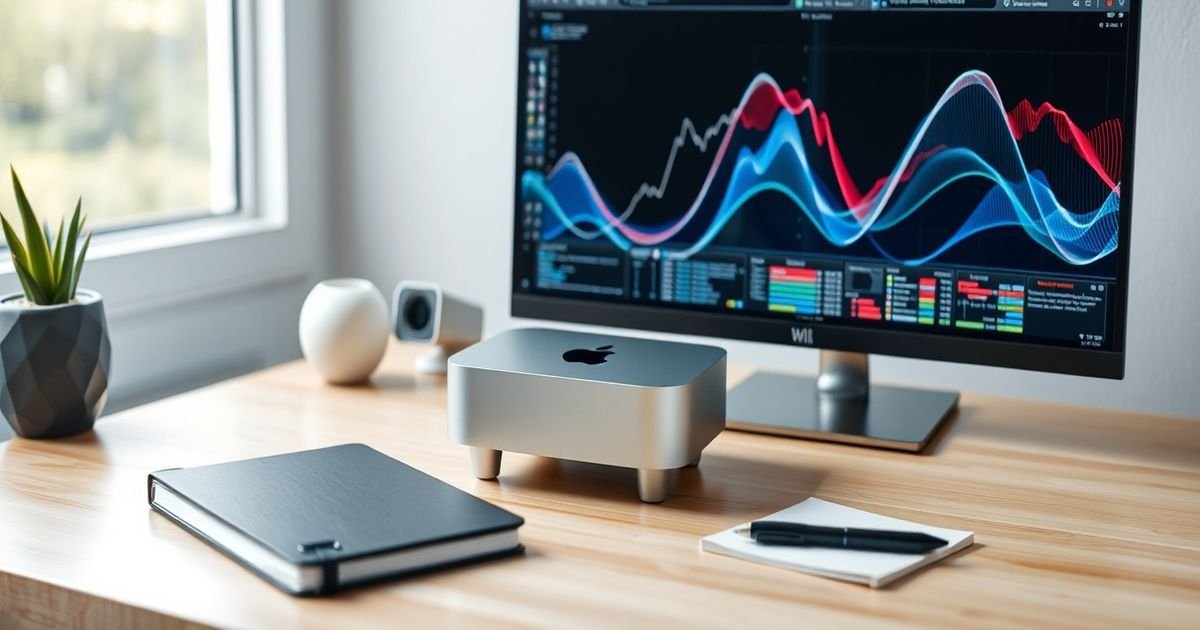
The mac mini m3 represents Apple’s relentless push to redefine compact computing. Launched in late 2025 and dominating discussions throughout 2026, this iteration leverages the formidable M3 chip to deliver unprecedented power in a footprint smaller than many external hard drives. For professionals, creatives, and home users seeking a silent, efficient, and capable desktop without the bulk of a tower, the mac mini m3 is a compelling proposition. This review dives deep into its real-world performance, design nuances, and whether it justifies its position as a top desktop choice this year. Understanding its capabilities is crucial for anyone evaluating a high-performance, space-saving solution.
Mac Mini M3: Compact Powerhouse Redefined
The mac mini m3 shatters expectations for what a small-form-factor desktop can achieve. Encased in the same iconic 7.7-inch square aluminum chassis as its predecessors, it houses Apple’s M3 system-on-a-chip (SoC), featuring an 8-core CPU, 10-core GPU, and 16-core Neural Engine. This translates to significant leaps in both raw processing power and graphics capability compared to the M2 model, particularly beneficial for video editing, 3D rendering, and machine learning tasks. Crucially, the M3’s efficiency cores handle background tasks with minimal energy consumption, while the performance cores kick in seamlessly for demanding workloads. The unified memory architecture (available in 16GB or 24GB configurations) ensures lightning-fast data access for all components. This isn’t just a minor spec bump; it’s a fundamental shift making the mac mini m3 a viable primary machine for serious users. Its near-silent operation, thanks to the fanless design under typical loads, is a major advantage for distraction-free environments.
Performance Benchmarks and Real-World Use
Benchmarks consistently place the mac mini m3 ahead of many mid-range Windows desktops and even some entry-level workstations. In Geekbench 6, it scores approximately 3,100 (single-core) and 12,500 (multi-core), while the GPU handles complex tasks like 4K video exports in Final Cut Pro significantly faster than the M2 variant. Real-world usage confirms this: compiling code, running multiple virtual machines, or editing high-resolution photos in Adobe Lightroom feels effortless. The M3’s media engine accelerates ProRes encode/decode, making it exceptional for video professionals. However, sustained heavy workloads like long 8K video renders will eventually engage the fan, though noise levels remain remarkably low. For most users – developers, designers, office professionals – the performance is consistently smooth and responsive. According to Apple, the M3 delivers up to 20% faster CPU performance and 30% faster GPU performance than the M2. This translates directly to a more fluid, productive experience daily.
Key Specifications at a Glance
Understanding the hardware is essential for evaluating the mac mini m3‘s value proposition. Here are the critical specs defining its 2026 relevance:
- Chip: Apple M3 (8-core CPU, 10-core GPU, 16-core Neural Engine)
- Memory: 16GB or 24GB unified memory (soldered, non-upgradeable)
- Storage: 512GB, 1TB, or 2TB SSD (blazing fast NVMe speeds)
- Ports: 2x Thunderbolt 4 (USB-C), 2x USB-A, HDMI 2.1, Gigabit Ethernet, 3.5mm headphone jack
- Connectivity: Wi-Fi 6E, Bluetooth 5.3
- Power: 150W power adapter, energy-efficient operation
- OS: Ships with macOS Sonoma, upgradeable to future versions
This configuration ensures excellent connectivity and future-proofing, though the lack of user-upgradeable RAM or storage remains a consideration for long-term flexibility.
Pros and Cons: The Balanced Verdict
No device is perfect. Here’s a clear breakdown of the mac mini m3‘s strengths and limitations:
- Exceptional Performance-to-Size Ratio: Unmatched power in an incredibly small, silent chassis.
- Industry-Leading Efficiency: Minimal power draw (often under 30W under load) translates to lower electricity bills and heat.
- Robust Connectivity: Thunderbolt 4 ports offer immense flexibility for displays and peripherals; HDMI 2.1 supports high-refresh 4K/8K.
- Seamless macOS Integration: Optimized for Apple ecosystem features like Continuity, Universal Control, and AirPlay.
- Silent Operation: Fanless design for most tasks ensures a quiet workspace.
- Non-Upgradeable RAM/Storage: Configurations must be chosen upfront; adding more later is impossible.
- Base Model Storage Limitation: 512GB base SSD may feel restrictive for media-heavy users; upgrading at purchase is costly.
- Limited GPU Options: Unlike some Windows desktops, GPU power is fixed by the M3 chip choice (no discrete GPU option).
- Price Premium: Higher starting price than some Windows mini PCs, though justified by performance and macOS.
Ideal Use Cases for the Mac Mini M3
The mac mini m3 shines brightest in specific scenarios where its blend of power, size, and efficiency is paramount. It’s the ultimate home office or remote work machine, easily driving multiple high-resolution displays while staying cool and quiet on a desk. Creative professionals, especially those in video (ProRes acceleration is key) or photo editing, will appreciate the smooth performance within macOS applications. Developers benefit from the Unix-based environment and robust processing for coding and testing. It’s also an excellent media center hub, capable of handling 4K/8K streaming and light gaming. For users deeply embedded in the Apple ecosystem (iPhone, iPad, AirPods), the seamless integration is a massive productivity booster. If you prioritize a clutter-free, high-performance desktop that disappears into your workspace, the mac mini m3 is hard to beat. For more insights, explore our resources on optimizing your home office setup.
Conclusion: Is the Mac Mini M3 Worth It in 2026?
The mac mini m3 solidifies Apple’s dominance in the compact desktop market. It delivers remarkable performance, exceptional energy efficiency, and a near-silent operation within a truly minimal footprint. While the non-upgradeable nature and base storage limitations are drawbacks, the overall package is compelling for professionals and power users seeking a reliable, high-performing machine. Its value is particularly evident for macOS loyalists and those prioritizing a clean, efficient workspace. If your workflow demands significant processing power without sacrificing desk space or tranquility, the mac mini m3 is a top-tier choice in 2026. It represents not just an incremental update, but a significant step forward in making powerful computing accessible and unobtrusive. For those considering alternatives, understanding the trade-offs between upgradability and integrated performance is key. To delve deeper into desktop comparisons, visit here. As noted on Wikipedia, the Mac Mini line has consistently pushed the boundaries of small-scale computing, and the M3 model continues this proud tradition with impressive results.